
Water Chemistry in Beverage Flavors

Why Water Chemistry Matters in Beverage Manufacturing
Water chemistry in beverage manufacturing is the silent architect of product quality, consistency, and consumer satisfaction. While flavorists focus on creating compelling taste profiles and procurement teams negotiate ingredient costs, water—often comprising 85-95% of finished beverage products—remains the most underappreciated variable in the formulation equation. For professionals at leading F&F houses like Mane, Givaudan, Kerry, and IFF, understanding water chemistry isn't optional—it's essential for delivering consistent flavor experiences across global manufacturing footprints. Regional water variations can dramatically alter taste perception, stability, and shelf life, making water quality management a critical competency for modern beverage development.This guide provides actionable insights for flavorists and procurement professionals seeking to master water chemistry parameters, implement robust testing protocols, and ensure flavor consistency regardless of manufacturing location.
What Is Water Chemistry in Beverage Manufacturing?
Water chemistry in beverage manufacturing refers to the analysis and control of chemical parameters in water used as an ingredient, processing aid, or cleaning agent in beverage production. These parameters—pH, total dissolved solids (TDS), hardness, alkalinity, chlorine content, and turbidity—directly impact flavor profile development, ingredient interactions, product stability, and equipment performance.The EPA Safe Drinking Water Act establishes primary and secondary standards for over 90 contaminants, but beverage manufacturers often require water quality specifications that exceed municipal drinking water standards. According to industry data, breweries and beverage facilities using advanced reverse osmosis systems can achieve TDS recovery rates as high as 98%, enabling unprecedented control over mineral content and flavor consistency.
Critical Water Parameters Every Flavorist Must Understand
1. pH Levels: The Flavor Balance Foundation
pH in beverage manufacturing typically ranges from 6.5 to 8.5 for optimal ingredient compatibility and microbial control. Small pH variations significantly impact formulation outcomes—the difference between pH 5 and pH 4 represents a ten-fold increase in acid concentration.Why pH matters for flavorists:
Ingredient reactivity: pH affects how acids, sweeteners, and flavor compounds interact Microbial stability: Proper pH controls spoilage organism growth
Color stability: Many natural colors are pH-sensitive and can shift dramatically
Mouthfeel perception: pH influences perceived tartness and refreshment
Best practices:
Monitor pH continuously using inline process analyzers
Maintain calibration schedules for pH meters (weekly verification recommended)
Document seasonal variations in source water pH
Adjust formulation buffers when source water pH shifts exceed ±0.3 units
2. Total Dissolved Solids (TDS): The Mineral Content Indicator
TDS measures the combined concentration of dissolved minerals, salts, and organic matter in water, typically expressed in milligrams per liter (mg/L). For beverage manufacturing, optimal TDS levels generally fall between 50-500 mg/L, though specific applications may require tighter control. The World Health Organization and EPA note that TDS above 1,000 mg/L can affect taste perception, while levels below 50 mg/L may indicate corrosive water conditions that can damage equipment and leach metals into products.
TDS impact on beverage formulation:
Flavor masking: High TDS can suppress subtle flavor notes
Carbonation efficiency: Mineral content affects CO₂ solubility and bubble retention
Ingredient solubility: Certain functional ingredients require specific ionic strengths
Regional consistency: TDS variations between facilities create formulation challenges
Testing recommendations:
Conduct TDS analysis using conductivity meters (TDS = conductivity × 0.5-0.7 conversion factor)
Implement daily testing for incoming water supplies
Use RO systems to standardize TDS across multiple production facilities
3. Water Hardness: Calcium and Magnesium Balance
Water hardness is defined as the concentration of calcium and magnesium ions, measured as calcium carbonate (CaCO₃). For beverage applications, ideal hardness ranges from 30-270 mg/L as CaCO₃.
Hardness classifications:
Soft water: 0-60 mg/L CaCO₃
Moderately hard: 61-120 mg/L CaCO₃• Hard water: 121-180 mg/L CaCO₃
Very hard: >180 mg/L CaCO₃
Flavor implications:
Calcium content: Enhances mouthfeel but can cause precipitation with certain acids
Magnesium levels: Affects bitter perception and can interact with hop compounds in brewed beverages
Scale formation: Hard water deposits reduce heat exchanger efficiency by up to 30%
4. Alkalinity: The Buffering Capacity
Alkalinity measures water's ability to neutralize acids, primarily through carbonate, bicarbonate, and hydroxide ions. For beverage manufacturing, alkalinity between 50-150 mg/L as CaCO₃ provides optimal buffering without interfering with acidification requirements.
Why alkalinity matters:
pH stability: High alkalinity resists pH adjustments, requiring more acidulant
Flavor balance: Excess alkalinity creates flat, chalky taste perceptions
Equipment protection: Proper alkalinity prevents corrosion in stainless steel systems
Testing protocol: Titrate water sample with standardized acid using phenolphthalein and methyl orange indicators to determine total alkalinity.
5. Chlorine and Disinfection Byproducts
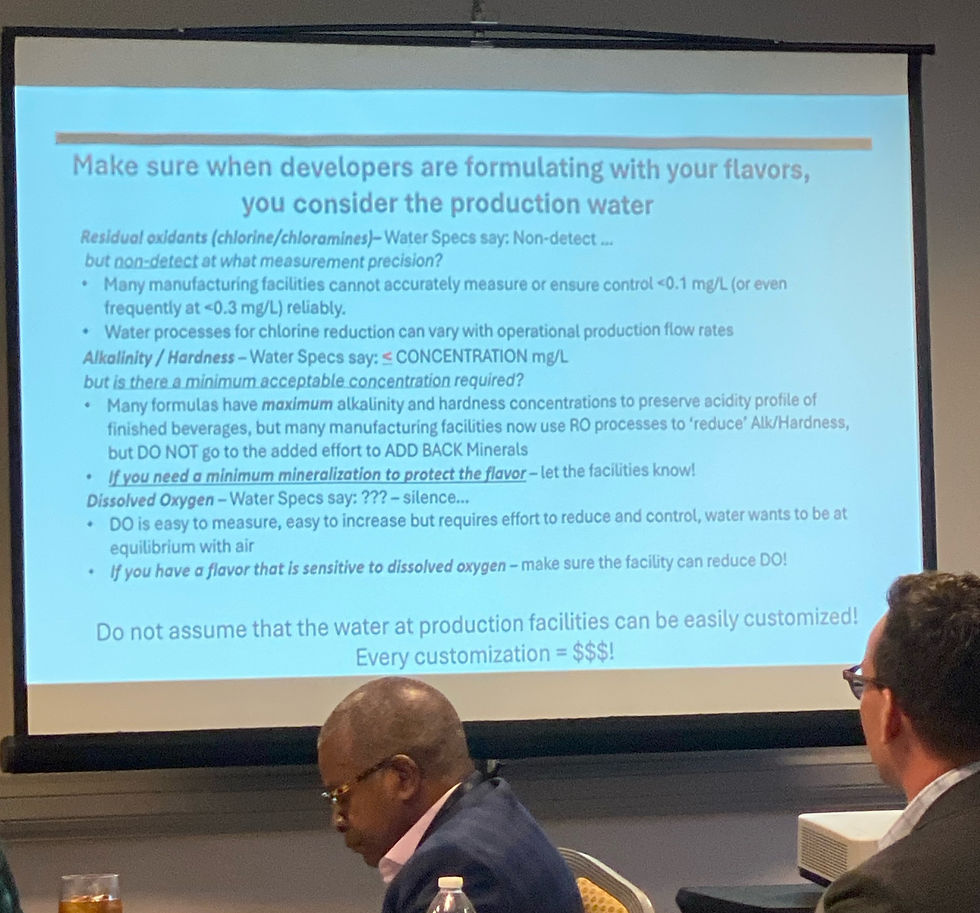
Chlorine residuals in municipal water typically range from 0.2-4.0 mg/L, but beverage applications require dechlorination to <0.1 mg/L to prevent off-flavors and ingredient degradation.Flavorist alert: Chlorine reacts with organic compounds to form chlorophenols, which create medicinal, plastic-like off-notes detectable at parts-per-billion levels. Phenolic flavor compounds are particularly susceptible to chlorine interference.
Dechlorination methods:
Activated carbon filtration (most common)
Sodium metabisulfite addition
UV treatment
AerationProcurement tip: Specify carbon block filters with 0.5-micron ratings and verify chlorine reduction through DPD colorimetric testing.
6. Turbidity and Suspended Solids
Turbidity measures water clarity through light scattering, reported in Nephelometric Turbidity Units (NTU). Beverage manufacturing typically requires NTU levels below 1.0 for ingredient water and below 0.1 for premium bottled water applications.
Quality implications:
High turbidity indicates filtration failures or biofilm presence
Particulate matter provides attachment sites for microorganisms
Visual clarity affects consumer perception of quality
Regional Water Variations and Flavor Consistency Challenges
Understanding Geographic Water Chemistry Differences
Water chemistry varies dramatically across manufacturing regions, presenting formulation consistency challenges for global F&F houses. Procurement professionals must account for these variations when qualifying new manufacturing partners or expanding production capacity.Regional water characteristics are summarized in the following table:
Region | Typical Hardness | pH Range | Common Challenges |
Northeast US | 50-150 mg/L | 6.8-7.5 | Chlorine levels vary seasonally |
Southeast US | 10-100 mg/L | 6.5-7.0 | High organics, color issues |
Midwest US | 150-300+ mg/L | 7.2-8.0 | Very hard water, iron content |
Western Europe | 100-300 mg/L | 7.0-8.0 | Varies by limestone geology |
Managing Multi-Facility Formulation Consistency
Best practices:
Standardize on RO-treated water for critical formulations to eliminate regional variations
Document source water profiles for each manufacturing location
Adjust flavor loadings ±5-15% based on local water mineral content
Require pre-shipment water testing when qualifying new co-manufacturers
For flavorists:
Build water specification matrices for each production facility
Create "water adjustment protocols" for regional variations
Validate flavor performance across minimum 3 different water profiles during development
Water Testing Methods and Quality Control Protocols
Essential Testing Equipment for Beverage Manufacturing
Inline/Process Analyzers:
· pH meters with automatic temperature compensation
· Conductivity/TDS sensors
· Chlorine residual analyzers (amperometric or colorimetric)
· Turbidity meters
Laboratory Testing:
· Titration setups for hardness and alkalinity
· Spectrophotometers for metals and specific ions
· HPLC or ion chromatography for detailed mineral profiles
· Microbiological testing (total plate count, coliforms)
Recommended Testing Frequencies
See table below for testing frequency recommendations:
Parameter | Incoming Water | Process Water | Finished Product |
pH | Continuous | Continuous | Batch test |
TDS | Daily | Continuous | Weekly |
Hardness | Weekly | Monthly | N/A |
Alkalinity | Weekly | Monthly | N/A |
Chlorine | Daily | Continuous | N/A |
Turbidity | Continuous | Continuous | Visual |
Microbiology | Monthly | Weekly | Per batch |
Building a Risk-Based Testing Program
Step 1: Map water usage — Identify all points where water contacts product or product-contact surfaces
Step 2: Assess risk levels — Categorize applications as high-risk (ingredient water), medium-risk (CIP/rinsing), or low-risk (cooling/heating)
Step 3: Establish specifications — Define acceptable ranges for each parameter based on product requirements
Step 4: Implement monitoring — Deploy appropriate testing methods based on risk level and criticality
Step 5: Document and trend — Maintain records to identify seasonal patterns and gradual changes
Best Practices for Water Management in Beverage Formulation
For Flavorists: Optimizing Flavor Performance
1. Request water profiles from all manufacturing partners before finalizing formulations
2. Develop "water-adjusted" flavor versions for facilities with challenging water chemistry
3. Test flavor stability in water representing the 90th percentile of expected variation
4. Document water-flavor interactions in formulation notebooks for future reference
5. Collaborate with procurement to establish water quality requirements in supplier agreements
For Procurement Professionals: Supplier Qualification
6. Include water quality specifications in RFPs and supplier contracts
7. Require third-party water testing during facility audits
8. Verify treatment system capabilities (RO capacity, carbon filter specifications)
9. Request water monitoring records for past 12 months
10. Establish corrective action protocols for out-of-specification events
Water Treatment Technology Selection Guide
The following table provides guidance on treatment selection:
Challenge | Recommended Treatment | Expected Performance |
High TDS/Hardness | Reverse Osmosis | 95-99% mineral reduction |
Chlorine/Chloramines | Activated Carbon | <0.1 mg/L residual |
pH Adjustment | CO₂ injection or acid feed | ±0.2 pH precision |
Microbial Control | UV (254nm) + Ozone | 4-log pathogen reduction |
Turbidity/Sediment | Multimedia filtration | <0.5 NTU output |
Frequently Asked Questions (FAQ)
Q: What is the ideal TDS level for beverage manufacturing?
A: The ideal TDS level for most beverage manufacturing applications ranges from 50-500 mg/L. Premium bottled water applications typically target 50-250 mg/L for clean taste profiles, while certain brewed beverages may benefit from 100-300 mg/L for enhanced mouthfeel. TDS below 50 mg/L can create flat-tasting water and may indicate corrosive conditions, while TDS above 500 mg/L can suppress delicate flavors and affect carbonation retention.
Q: How does water hardness affect beverage flavor?
A: Water hardness affects beverage flavor through calcium and magnesium interactions with acids, sweeteners, and flavor compounds. High hardness (>180 mg/L CaCO₃) can create chalky mouthfeel, reduce perceived sweetness, and cause precipitation with certain organic acids. Calcium enhances body and mouthfeel but can form insoluble complexes. Magnesium amplifies bitter perception, which can be desirable in some applications but problematic in delicate flavor systems. Many beverage manufacturers use water with 30-120 mg/L hardness as a balance between flavor impact and equipment protection.
Q: Why must chlorine be removed from water used in beverage production?
A: Chlorine must be removed from beverage production water because it reacts with organic compounds to form chlorophenols and other off-flavor compounds detectable at parts-per-billion concentrations. Even at low levels (0.1-0.5 mg/L), chlorine oxidizes flavor compounds, degrades vitamins and sensitive ingredients, and creates medicinal or plastic-like off-notes. The FDA recommends dechlorination to <0.1 mg/L for ingredient water. Activated carbon filtration is the most common removal method, achieving >99% reduction when properly maintained.
Q: What water testing is required for beverage manufacturing compliance?
A: Beverage manufacturing compliance requires both microbiological and chemical water testing meeting FDA bottled water standards and EPA Safe Drinking Water Act requirements. Minimum testing includes: (1) Microbiological analysis for total coliforms and E. coli monthly; (2) pH and TDS monitoring at least weekly; (3) Heavy metals testing (lead, arsenic, mercury) annually; (4) Disinfection byproduct monitoring quarterly for facilities using chlorinated source water. Additional testing for hardness, alkalinity, and specific ions should be conducted based on product requirements and source water variability.
Q: How do regional water variations impact beverage formulation?
A: Regional water variations impact beverage formulation through differences in mineral content, pH, alkalinity, and treatment chemicals that alter ingredient interactions and flavor perception. A formulation developed using soft, low-TDS water (West Coast US, 50-100 mg/L) may taste bland or unbalanced when produced with hard, high-alkalinity water (Midwest US, 250+ mg/L). Flavorists must either: (1) Standardize water through RO treatment across all facilities, (2) Develop regional flavor adjustments (+/- 5-15% loading), or (3) Create formulation buffers that perform consistently across water profiles. Procurement teams should specify water quality standards in supplier agreements to ensure consistency.
Q: What is the difference between alkalinity and pH in water testing?
A: Alkalinity measures water's capacity to neutralize acids (buffering ability), while pH measures the current acidity or basicity of water. A water sample can have high pH but low alkalinity, or vice versa. Alkalinity is determined by carbonate, bicarbonate, and hydroxide concentrations, reported as mg/L CaCO₃. pH is measured on a 0-14 scale. For beverage manufacturing, alkalinity between 50-150 mg/L provides stable pH without interfering with acidulation. High alkalinity (>200 mg/L) resists pH adjustments, requiring more acidulant to achieve target beverage pH, while low alkalinity (<30 mg/L) creates pH instability and potential corrosive conditions.
Q: Which water treatment method is best for beverage manufacturing?
A: Reverse osmosis (RO) combined with activated carbon filtration is the best water treatment approach for most beverage manufacturing applications requiring flavor consistency. RO removes 95-99% of dissolved minerals, eliminating regional water variations and providing a blank canvas for formulation. Activated carbon removes chlorine, chloramines, and organic compounds that affect taste. Additional treatments may include: UV disinfection for microbial control, pH adjustment systems for precise acidification, and polishing filters for turbidity control. The optimal treatment train depends on source water quality and specific product requirements—facilities with high-hardness well water require different approaches than those using municipal surface water.
Actionable Takeaways
For Flavorists:
· Always request water quality data before beginning new formulations
· Test flavors across multiple water profiles to ensure robustness
· Document water-flavor interactions for institutional knowledge
· Build relationships with procurement to influence water quality specifications
· Consider water chemistry when troubleshooting off-flavor complaints
For Procurement Professionals:
· Include water quality requirements in all supplier contracts
· Verify treatment capabilities during facility qualifications
· Request historical water data to assess consistency
· Plan for seasonal variations in source water quality
· Budget for water treatment upgrades when necessary for quality
For Cross-Functional Teams:
· Establish water quality KPIs tied to product consistency metrics
· Conduct regular water audits at all manufacturing locations
· Develop contingency plans for water quality emergencies
· Invest in inline monitoring for real-time quality control
· Train production staff on water quality importance and testing procedures
Conclusion: Elevating Beverage Quality Through Water Chemistry Mastery
Water chemistry in beverage manufacturing represents the intersection of science, art, and operational excellence. For flavorists creating the next generation of beverages and procurement professionals ensuring quality across global supply chains, water chemistry mastery is a competitive differentiator. The leading F&F houses—Mane, Givaudan, Kerry, IFF—understand that consistent water quality enables consistent flavor experiences. By implementing robust testing protocols, understanding regional variations, and investing in appropriate treatment technologies, beverage manufacturers can ensure that water enhances rather than undermines their carefully crafted formulations. As the beverage industry continues to evolve toward clean label, natural positioning, and functional benefits, water quality will only grow in importance. The companies that master water chemistry today will lead the market tomorrow.
About Aromiens
Aromiens partners with flavorists and procurement professionals in the F&F industry to deliver high quality natural aroma chemical, sweeteners and other natural molecules.
Comments